

Struggling?
How to get flowing again


We’ve all had the experience.
Things are flowing along.
We feel a sense of expansiveness.
Life is going well.
We’re getting green lights and parking spaces.
Positive signs.
We feel so good!
And then, everything changes.
Sometimes it’s a gradual slowing down.
Other times, an unexpected obstacle appears on the scene.
Someone or something challenges our sense of safety.
We react.
Whether struggle comes from an inner dilemma or an outer event, it’s often accompanied by confusion.
We don’t know what to do next.
Creativity fizzles, energy wanes.
We might even get physically sick, suffer from an injury, muscle aches, a cold, or an unexpected diagnosis.
Whenever struggle or stuck feelings happen, in whatever form, it’s natural to resist.
We want what came so easily before.
Clarity.
Excitement.
Expansiveness.
Flow!
Instead, it can feel like life is closing in on us, getting darker, smaller.

Very non-flowy!
One of the first things I like to remember in times like this is that “not flowing” is as natural as “flow.”
That doesn’t mean we “should” stay in struggle or suffer unnecessarily.
It does mean, however, that when we are committed to consciously working with flow as a habit, and making flow a way of life, it is essential to to not make non-flow experiences wrong.
The truth is, struggle is part of a continuum, one of several processes involved in flow, like finally touching ground after riding a long wave into shore.
We need all the phases of flow to keep flowing including rest and yes, even struggle.
It is often from angst that we find our energy from which to flow.
What Phase of Flow Are You In Right Now?
In my book The Flow Habit, and in my earlier article What Does Your Flow Rhythm Look Like?, I introduce The SAFER Flow Cycle. This is rooted in the work of Herbert Benson, M.D., the Harvard cardiologist who uncovered the power of “relaxation response” long before “calming the nervous system” was in vogue.
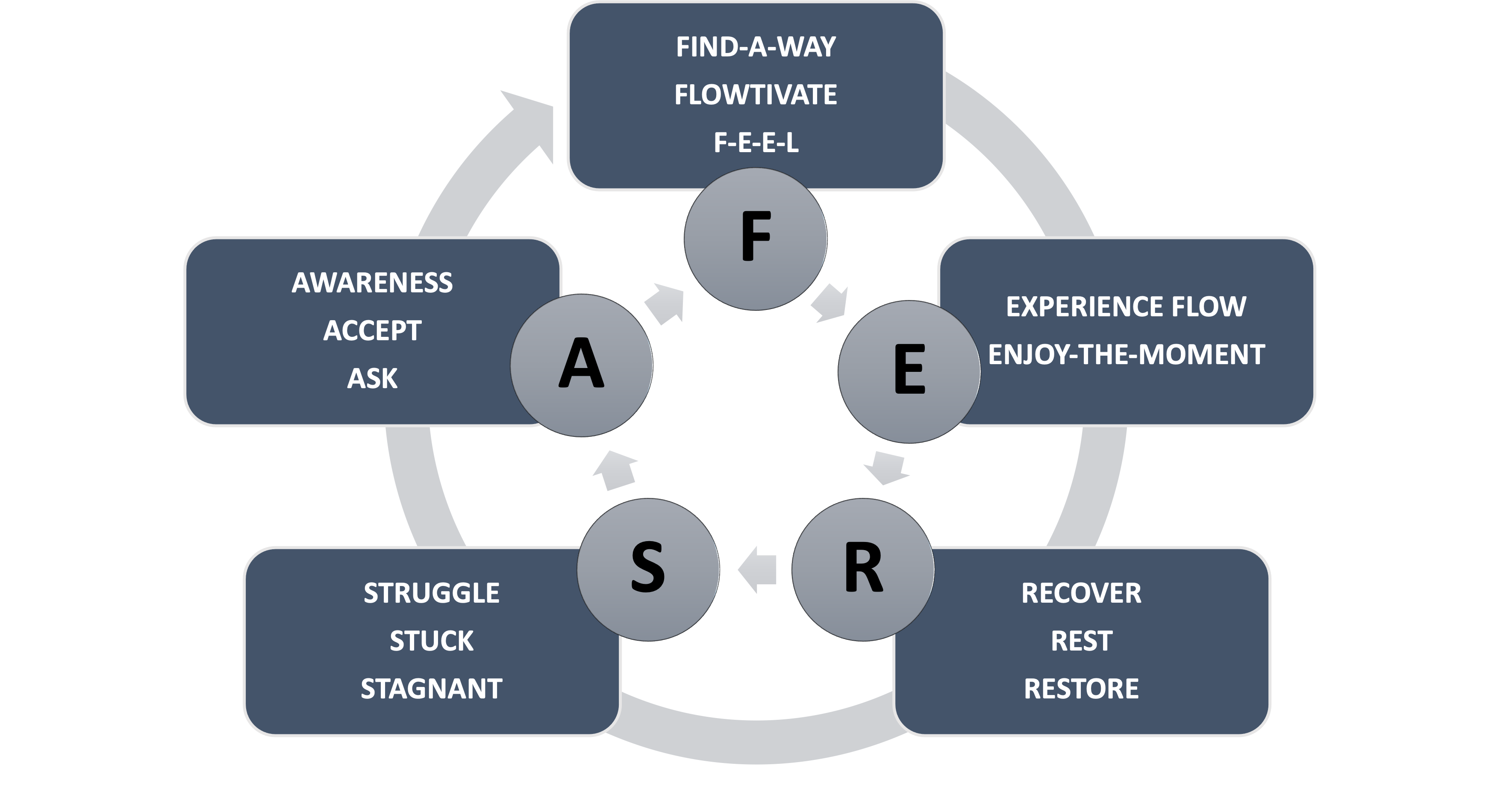
(This graphic is copyrighted and appears in my book The Flow Habit (Hay House/Penguin Random House, December 2025). More information about “Flowtivate” and the four “F-E-E-L” steps are included in the book.)
I’ve chosen the acronym SAFER for two reasons:
Creating emotional safety for ourselves and others is the #1 driver of flow experiences, a fact that has long been overlooked by flow experts.
Our businesses, relationships, and well-being are truly SAFER, as in more resilient and able to last for the long-term, when we really understand how flow works and are consciously working to make flow a habit, a way of life (which is why I named my book The Flow Habit).
Once we come to know the five phases of the SAFER Flow Cycle, we can work with them, rather than against them, to find our flow again.
How to Move from Struggle to Acceptance
In The Flow Habit, I include a personal assessment tool you can use to identify which of the five phases you are in, in different areas of your life, and what to do about it.
For now, here’s how to identify if you’re in “struggle phase” of flow:
In the struggle phase of flow, you might feel creatively blocked.
You can feel scattered or overwhelmed.
You may be facing real-world challenges and don’t know the answer, or where to turn for support.
You might be experiencing money or energy shortages.
You could be having more frequent disagreements with others or find yourself having a lot of fights or conflicts.
Little annoyances might feel bigger than usual.
You might be feel anxious, find yourself ruminating or worrying about the future more than usual.
You might find yourself getting sucked into other people’s dramas or news, or feel overwhelmed by your ever-growing to-do list.
You might find it difficult to find things or be organized.
You could be having physical or health challenges.
Whatever you’re feeling, the first step to getting unstuck and flowing again is to know that it’s all okay.
There is no right or wrong way to feel, and no right or wrong way to flow.
Struggle is just one phase on the flow continuum—a sign that a creative breakthrough is just around the corner.
Getting Unstuck
Here are some questions to ask when you feel stuck.
#1: Are you depleted and in need of rest?
REST is the phase just before STRUGGLE in the cycle. We often skip or try to shorten rest to keep up with the go-go rapid pace of our world.
Rest is essential in order to integrate what happens during huge expressions of energy that happen during flow. Rest is when our “new normal” takes form.
If your struggle is coming from a lack of rest or integration, you might need to just wait out what you are experiencing a little longer and trust that a creative breakthrough is coming.
What gifts are you gaining?
It can also be helpful to name what you are learning, or the gifts, skills, and wisdom you have recently gained.
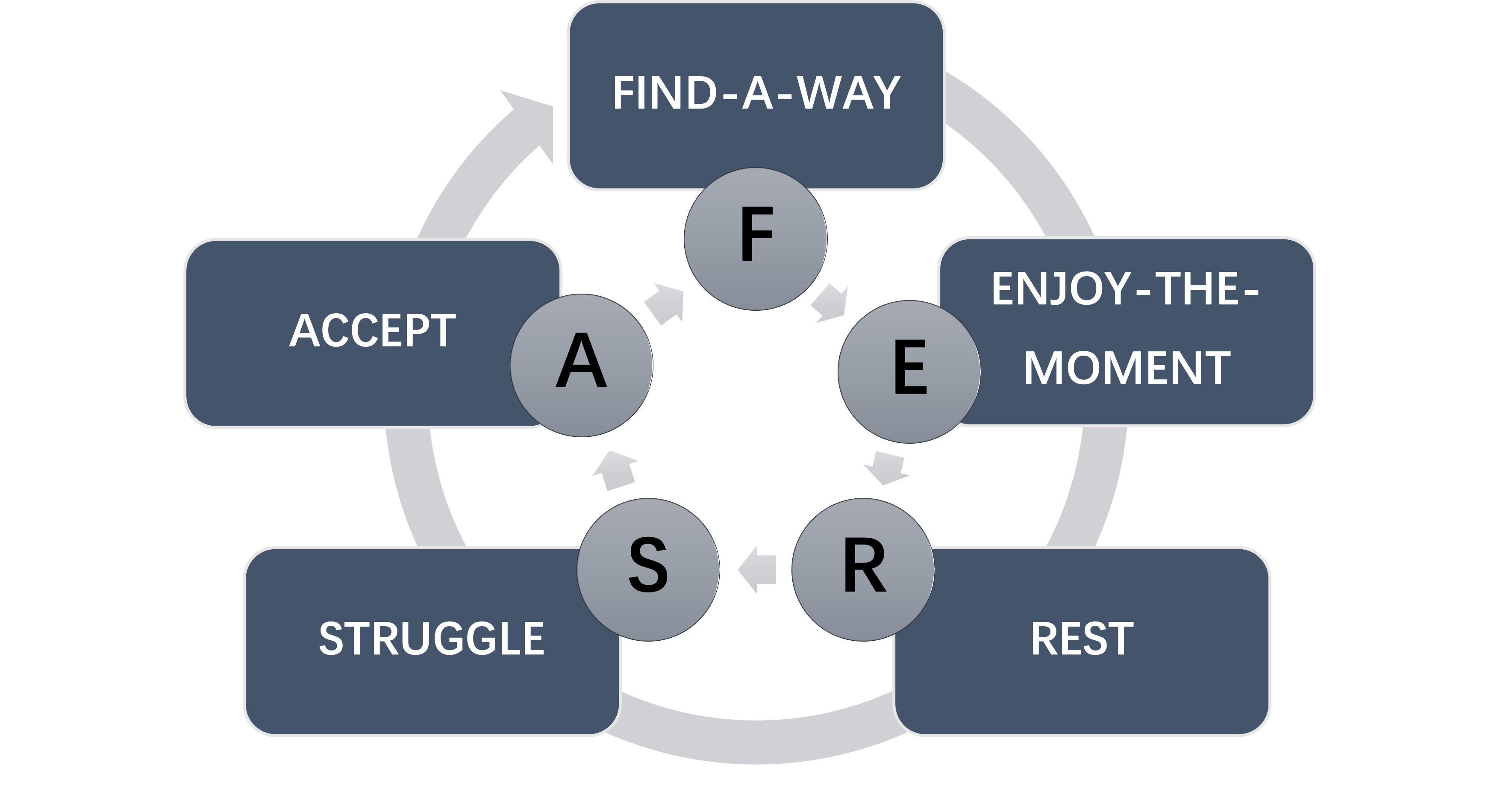
(This graphic is copyrighted and appears in my book The Flow Habit (Hay House/Penguin Random House, December 2025).
#2: Are you struggling over struggle?
Next, it can be helpful to ask if you might be making things more difficult than they need to be. We often do this when we are making struggle “wrong” or falling into the trap of thinking that we need to “do” more to struggle less.
Ask yourself the first question in the four steps to flow—FOCUS: (See The Flow Habit.)
What is your top priority in this moment?
When things aren’t flowing, it can be a sign that we are trying to do too much.
Have you taken on too many responsibilities or commitments?
Are you expecting too much of yourself or others?
Are you trying to do other people’s work for them (emotional or otherwise), or struggling over things that are beyond your control?
Simplifying Struggle
Make a List of “Open Loops”
One thing I like to do when I am feeling overwhelmed is make a list of open loops—unanswered questions or unfinished projects that my mind is working on behind-the-scenes.
Open loops, whether unfinished projects or mysteries to solve, take valuable brain power, which can negatively affect our ability to access flow.
After looking at your list, ask which can be put aside for the time being, or checked off your inner to-do list.
Clean Something
Another way to work with rather than against feelings of struggle can be to channel the energy of struggle into removing blocks in flow’s path.
The universe loves symbolic gestures. Start small with real-life physical clutter.
Clean a junk drawer, your wallet, or the inside of your car. Delete junk emails. Cancel appointments or extraneous commitments that don’t need to happen right now, or perhaps at all.
Keep it small and simple. Be careful not to give yourself more things to struggle over like a huge unfinished cleaning-out project.
Give yourself a small win that makes you feel good, and clears the path for flow in some small, sweet way.
Do the “I Feel” Meditation
Another thing that helps is reminding ourselves that whatever we are feeling is okay. In chapter three of The Flow Habit, I share a simple meditation you can use to work with any emotions that you experience, even challenging ones.
#3: Are you ignoring my intuition about something?
To experience high levels of flow, we need to have a strong relationship with our intuition. There is no way around this fact.
Flow is ultimately an intuitive experience, a time when we are intimately connected and aligned with our wise inner voice.
Sometimes, flow stops because our intuition is trying to tell us something we don’t want to hear. We might be feeling called to take a leap we don’t want to take.
Or, we might sense if we continue flowing in a specific direction, we might ultimately need to make a change that will take us out of our current comfort zone.
Struggle often stops when we create time and space to sit down and really hear our own inner call.
If this resonates with you, take a minute now to close your eyes and listen. Own what you are hearing, even if silently in your own soul.
Struggle is not a time for frantic actions, or throwing spaghetti on the wall to see what sticks. We might feel the urge to do that to diffuse the energy that can build up during tough times. Instead, it’s often more helpful, and more difficult, to sit in stillness with the feelings of discomfort and to see what’s behind them, to hear our intuitive calls.
Tell the side of you that has been overshadowed by outer events or busy activity that you hear it, you understand that something needs to change, and that you will make the change when the time is right, not before.
Tell the quiet voice beneath all the struggling that while you might not be ready to take action, you are ready to listen.
Hearing Your Inner Voice
Struggle is a good time to journal, and to find safe ways for that soft voice within to speak. There might be some action you have been procrastinating, which is the cause of your struggle. Whether it’s time to act or not, it’s essential to honor where you are feeling called to flow next.
Flow is always about growth and our own evolution. It could be that the destination where you are feeling called to go has changed and your inner GPS knows it. Your rational thinking mind, which is in charge of managing the minutia of real life, needs to catch up.
Struggle can be an opportunity to bring all these parts of yourself back into alignment again.
You might try these journaling prompts to remember and reclaim who you are. Remember, reclaiming emotional safety gives us firm ground off of which to launch and leap into flow.
Journaling Prompts
I love…
What I want most of all right now is…
Something that would be really fun is…
Soften and Reclaim Fun
Struggle is a very adult-like serious emotional state. The more we can soften around our own struggle, lighten up, and not take ourselves so seriously, the easier it becomes to get clarity about what our struggle is all about.
Struggle is the ideal time to choose a Flow Habit—a 5 minute activity that brings you joy, that you love to do. While this may not “solve” the source of your struggle (or at least it might not seem like it does directly), it can bring a playful, childlike joy back into your life in a way that is doable—only 5 minutes a day. We can always find five minutes!
Play, honoring our intuition, and accepting that all emotions are okay is how we find flow and reclaim our connection to our True Self, what I call the Flowing Self.
Find Flow with Play
We can find flow by remembering that struggle is just one stop on the path to flow. Stay with it and get clear about how your struggle is serving you.
Struggle is often a sign that deep transformation is happening. Like the changes that happen inside a chrysalis, struggle often means that the pieces of our lives and our identity are in the process of being rearranged.
If this article resonates with you, you might also want to listen to my podcast episode on getting unstuck, #3 in this month’s Clarity series. The Flow Habit podcast is available wherever you listen to podcasts.
And if you’re struggling, you’ve got this friend.
Sending you lots of compassion. I’m rooting for you!
Happy Flowing!
~ Laurie
Love all of this! Especially the journal prompts at the end. Trying this today!
Love this. So much useful inspiration, I had to save it to refer back to. I especially loved the prompts.